



There are no translations available.

Miroiterie générale (14) en liquidation judiciaire


La miroiterie d’Ifs (14) a été mise en liquidation et l’ensemble des machines de miroiterie (table de coupe, rectiligne PR/88...) vendues aux enchères le 15-05-2013

There are no translations available.

Les prochains axes d’action pour Cekal

L’association de certification Cekal a profité de son dernier conseil d’administration en avril pour définir sa stratégie pour l’année 2013. Elle va concentrer ses moyens sur 5 dossiers prioritaires.


1/Préparer CEKAL au passage à la nouvelle norme 17065 applicable aux organismes de certification de produits en 2014.
2/Préserver la qualité des vitrages certifiés par un renforcement des procédures de suivi des constituants.
3/Mettre à la disposition des utilisateurs de vitrages certifiés toutes les informations nécessaires au respect des réglementations nationales et des règlements européens.
4/Renforcer la traçabilité des produits, gage de leur qualité.
5/Augmenter la visibilité de la marque CEKAL auprès des professionnels du verre et des utilisateurs finaux, et assurer sa promotion, en investissant en particulier sur des supports Internet.

Deceuninck, 75 years in business

Deceuninck, one of the window industry’s most iconic names, is celebrating 75 years in business. Bernard Vanderper, Deceuninck UK’s interim Managing Director, said, “It is a great achievement for our company to have reached this significant milestone. Everyone who has worked at the company in the past or who works for us today has played a part in our company’s success and now is a good opportunity to thank them for their efforts. We should also thank our customers past and present because no matter how hard we might have worked, we could not have achieved anything without them.”

As you might expect for a company that is 75 years old, Deceuninck has seen some significant changes in its history. But for one of the best-known names in the window industry, perhaps the most surprising thing is that it didn’t start manufacturing window profiles until the 1960s! It was founded in 1937 by Benari Deceuninck, father of the current directors, to manufacture buttons and buckles from plastic sheeting. By the 1940s, the company had expanded, and was manufacturing plastic combs, packaging and toys.

The 1960s saw a radical change of direction and the Deceuninck we know today started to take shape with a move into the manufacture of roller shutters and cladding profiles for the building industry. At the end of the 60s, Deceuninck was one of the first companies in Europe to start the production of PVC window profiles.

Throughout the 80s and 90s Deceuninck continued to expand with the acquisition or founding of companies across Europe and in the US. The UK arm of the company was founded in 1981 as Deeplas. 1985 was a significant year for the company: it was the year that Deceuninck was first listed on the Brussels stock exchange and the UK headquarters in Calne were opened. By 1997, Deceuninck was the leading producer in the US and by 1999 it was in the UK top five. It became a world leading profile manufacturer in 2003.

Since 2009, Deceuninck have invested over £55 million into the 3 axis of its newly refocused long term strategy ‘Building a Sustainable Home’. This new vision defines its core purpose today to create innovative solutions in its four areas: Windows & Doors, Outdoor Living, Roofline & Cladding and Interior. It sees this as part of a wider commitment to help create homes with long-lasting, low maintenance residential building products with improved energy efficiency, low ecological footprint and the capacity to be fully recycled at end of life. On top of this, it is committed to giving individuals freedom of expression through unique colour and finish options.

In 2012 Deceuninck successfully concluded a refinancing agreement well ahead of maturity date. For the next 5 years, this new facility provides sufficient headroom and flexibility to further execute Deceuninck’s long term strategy and duly respond to an uncertain economic environment.

Bernard Vanderper concludes, “In a company that has been trading for 75 years there are always going to be good times and bad. The last few years have seen tough trading conditions for all businesses and our own was no exception. But we at Deceuninck are confident that we have been through the worst and that we have the building blocks in place for the next 75 years.”


There are no translations available.

Albat+Wirsam change de nom


Le leader des logiciels de miroiterie a décidé de changer de nom et va dorénavant opérer sous le nom de A+W.

La société Allemande a depuis quelques mois été vendue par le Finlandais Glaston au groupe canadien Friedmann Corporation.

Banner
Banner
Banner


Industrial straight line edging machines ( 8,10 and 11 wheels and more)

Here we speak about straight line edging machines for industrial glass processing productions. These machines can edge every thickness with possibility for important removal glass (generally up to 5 mm in only one time), and are able to adjust the arises width depending the glass thickness and to reach a bright polishing.
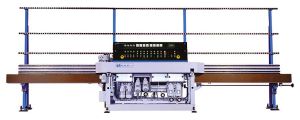


Cau edging machine

The more important difference between all these straight line edging machines is the speed. With an addition of one diamond wheel (difference between an 8 spindles and a 10 or 11 spindles) we increase the speed about 40% or 50%. (To give an idea, on 10 mm thickness with 8 spindles you can edge with a speed between 1,8 and 2 meters per minute. With a 10 spindles you can reach 2,8 meters and more than 3 meters per minute with an 11 spindles.


The other differences between a 10/11 spindles and an 8 spindles.

-In case a spindle is out of order with a 10/11 spindles toy can go on working, only reducing the speed. With an 8 spindles you have to stop working and to wait to repair the out of order spindle.

-For important thicknesses (19 mm or more) you can polish with felt + water with cerium oxide which improves a lot the polishing quality.


Others parameters to have a look.

-Maximum thickness in case you edge laminating glass.

-Maximum machine acceptable weight for the glass to be processed, always mainly  in case of laminating glass processing.

-The elements for productivity.

-The way to detect and adjust the polishing wheels wearing.

-The oiling (manual or automatic)

-The rapidity and accuracy to adjust the diamond wheels ( wearing and change)

-The maintenance


For this kind of machines, the offer is huge with big technical and purchase prices differences.

The machines comparison proposes 25 technical data, 15 trade marks and 66 machines from 15000 euros up to more than 100 000 euros


Chinese machines

They produce 2 different kinds of machines. One for their own market, the other for export. Even the last one are rustic. The Europeen service network is generally very weak.

Be careful also in this case about CE rules